

How To: Actually Get Faster (Hint: Running More Isn’t the Answer)
One of the biggest misconceptions we hear from athletes is:
“I need to get faster, so I need to run more.”
It sounds logical.
If running is how you display speed, then running more should make you faster… right?
Not exactly.
Running more and running faster are two very different training goals.
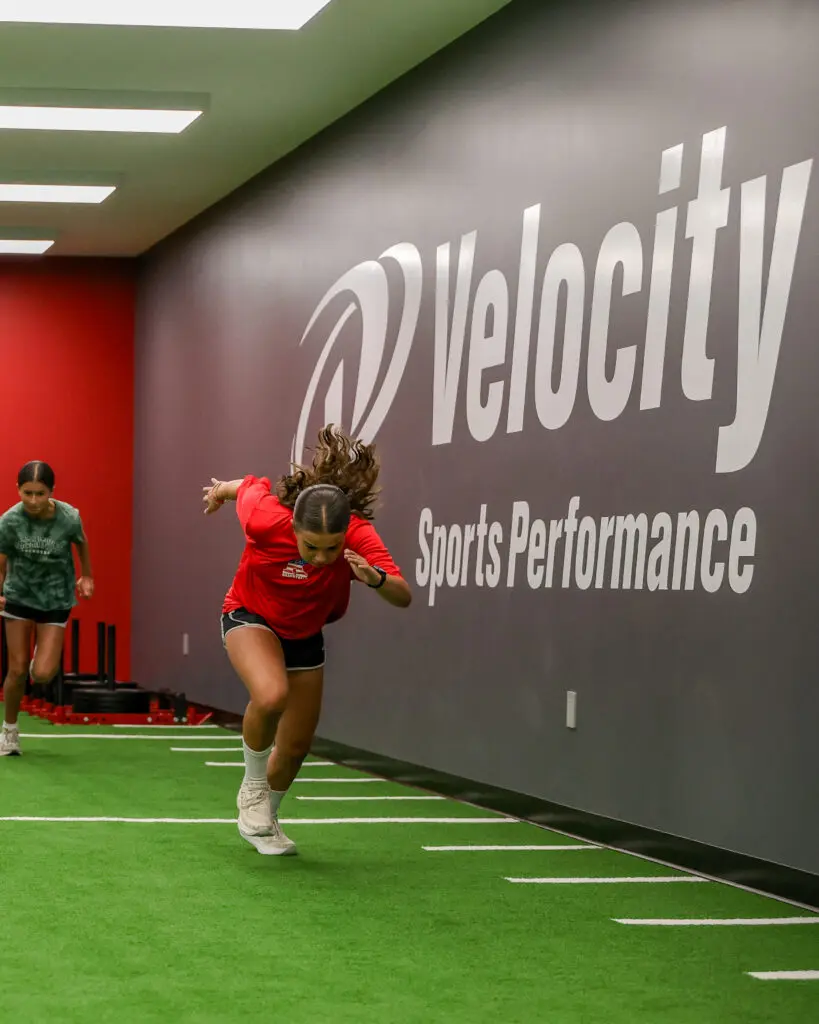
Going for longer runs can improve your aerobic fitness and your ability to sustain activity for longer periods of time. But if your goal is improving your 10-yard acceleration, reaching a higher top speed, or beating an opponent to the ball, simply adding more miles isn’t the answer.
Speed is a specific athletic quality.
And if you want to become faster…
At some point, you actually have to train fast.
Research on sprint training supports this idea. Athletes tend to improve most in the speeds and movement patterns they actually train, demonstrating what researchers refer to as velocity specificity (Kristensen et al., 2006).
The good news?
You don’t need to spend hours running to improve your speed.
You need to train the qualities that actually produce it.
Let’s dive into it!
Running More Isn’t the Same as Running Faster
First, we need to separate two things:
Endurance and speed.
Endurance is your ability to sustain activity and resist fatigue.
Speed is your ability to produce large amounts of force quickly and move your body from Point A to Point B as fast as possible.
Both matter for athletes.
But they’re not the same thing.
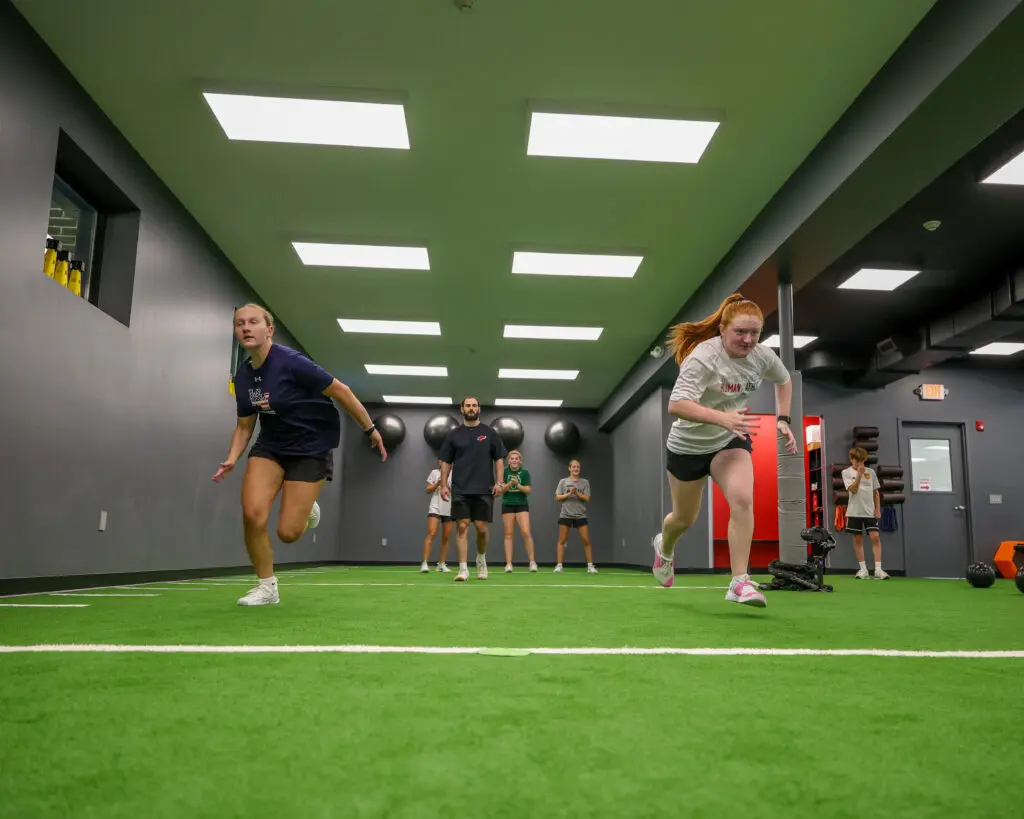
Think about a 10-yard sprint versus a two-mile run.
During the sprint, you’re trying to accelerate as aggressively as possible.
During the two-mile run, you’re intentionally choosing a pace you can sustain for several minutes.
Your body is solving two completely different problems.
So while running longer distances can improve your conditioning, you shouldn’t expect jogging at a slower pace to automatically make your 10-yard dash faster.
If you only practice moving slowly, you’re not giving your body enough opportunities to learn how to move FAST.
Your Body Adapts to What You Ask It to Do
This is one of the most important principles in training.
Your body adapts specifically to the demands you consistently place on it.
Want to get stronger?
You need to progressively challenge your ability to produce force.
Want to jump higher?
You need to develop strength, power, and explosive force production.
Want to get faster?
You need exposure to high-speed sprinting.
Research examining different sprint-training methods found that specific sprint training was highly effective for improving sprint performance across multiple distances (Rumpf et al., 2016).
Another study comparing different sprint-training velocities found that athletes improved the most under conditions similar to the speeds they actually trained at, supporting the principle of velocity-specific adaptation (Kristensen et al., 2006).
Simply put:
Your body gets better at what you train it to do.
Why Long, Slow Running Doesn’t Automatically Improve Short-Distance Speed
Longer-distance running absolutely has benefits.
It can improve:
- Aerobic capacity
- Cardiovascular fitness
- Work capacity
- Recovery between efforts
- General conditioning
Those qualities can be extremely valuable depending on your sport.
But here’s where athletes get confused.
Being able to run longer doesn’t necessarily mean you can run faster.
If your goal is improving a 10-, 20-, or 30-yard sprint, you’re asking your body to produce a tremendous amount of force in a very short period of time.
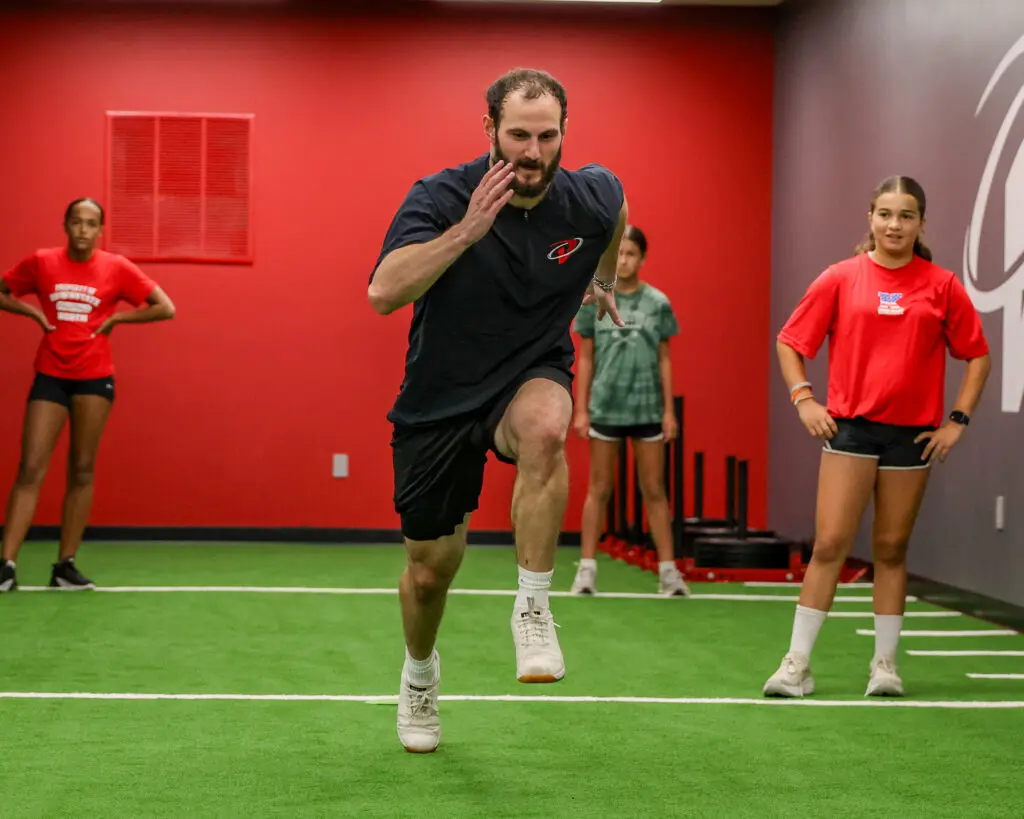
A longer run asks you to distribute your effort over a much greater amount of time.
That’s a completely different demand.
This is why an athlete can be in incredible cardiovascular shape and still not be particularly fast.
And the opposite can also be true.
An athlete can be extremely explosive over 10 yards without being able to run five miles particularly well.
They’re different athletic qualities.
Speed Is About Force
Getting faster isn’t just about moving your legs quicker.
You have to put force into the ground.
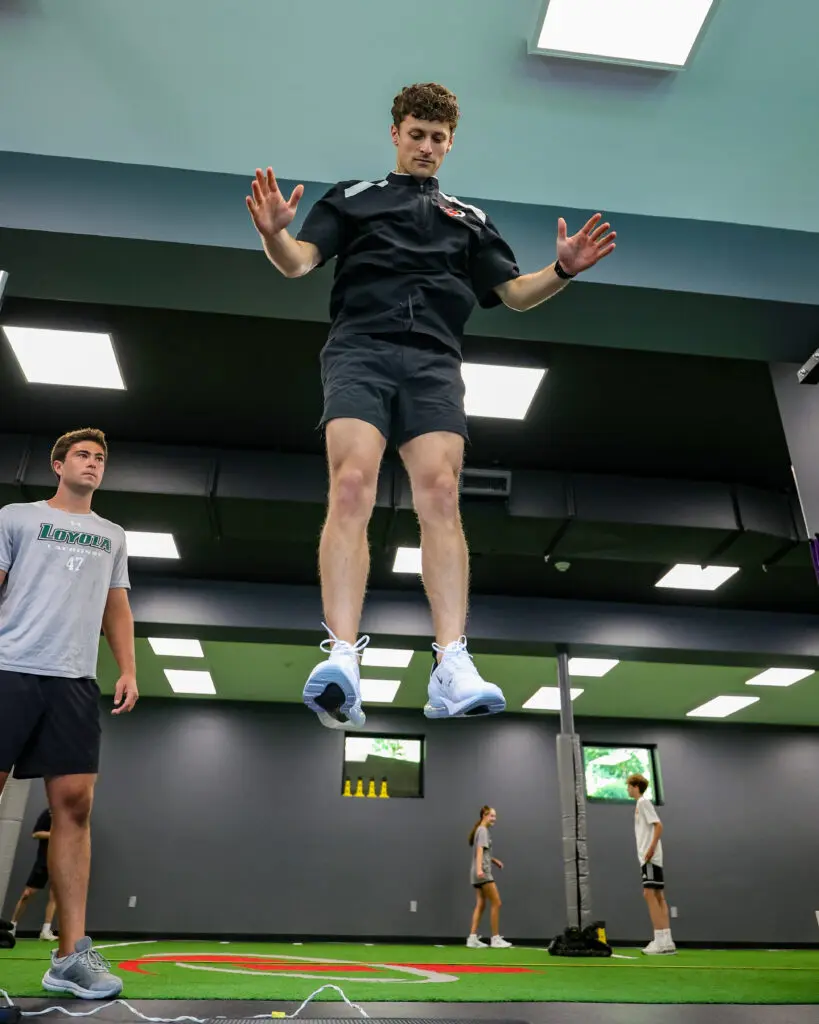
A lot of it.
And you have to do it quickly.
During acceleration, athletes need to apply large forces into the ground to propel their bodies forward. As speed increases, the amount of time available to apply that force becomes shorter.
That’s one reason strength and power training are so important for speed development.
Exercises like:
- Squats
- Trap-bar deadlifts
- Split squats
- Romanian deadlifts
- Jumps
- Bounds
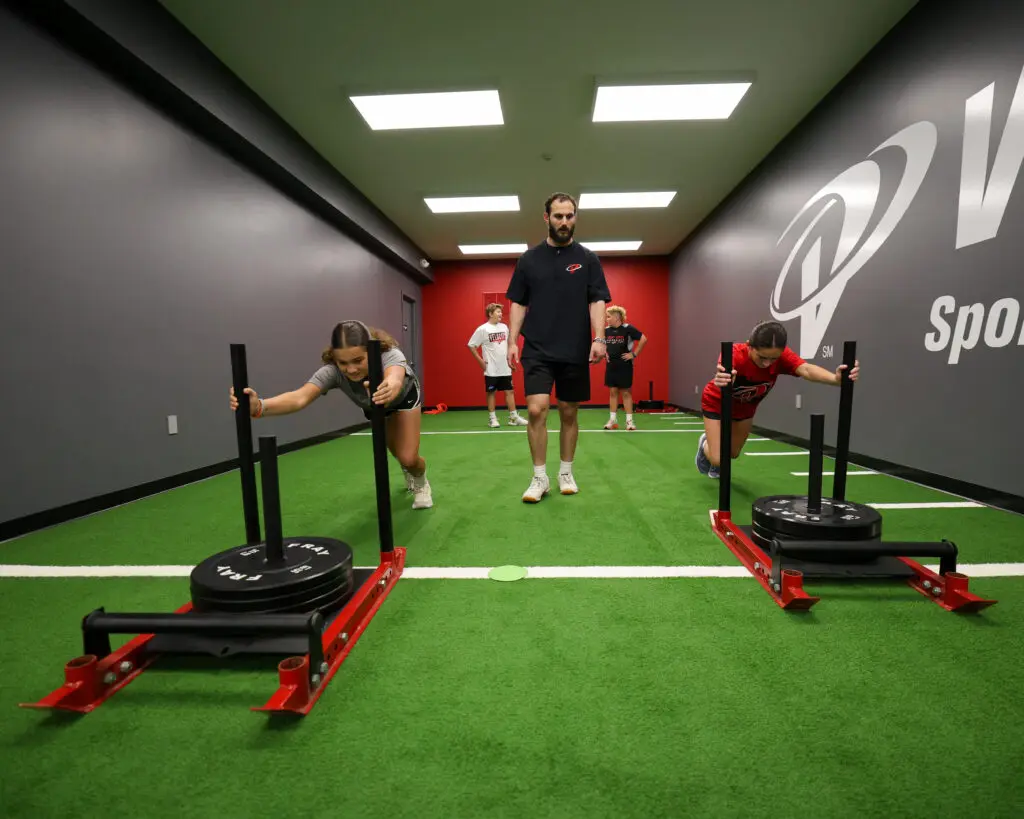
- Sled sprints
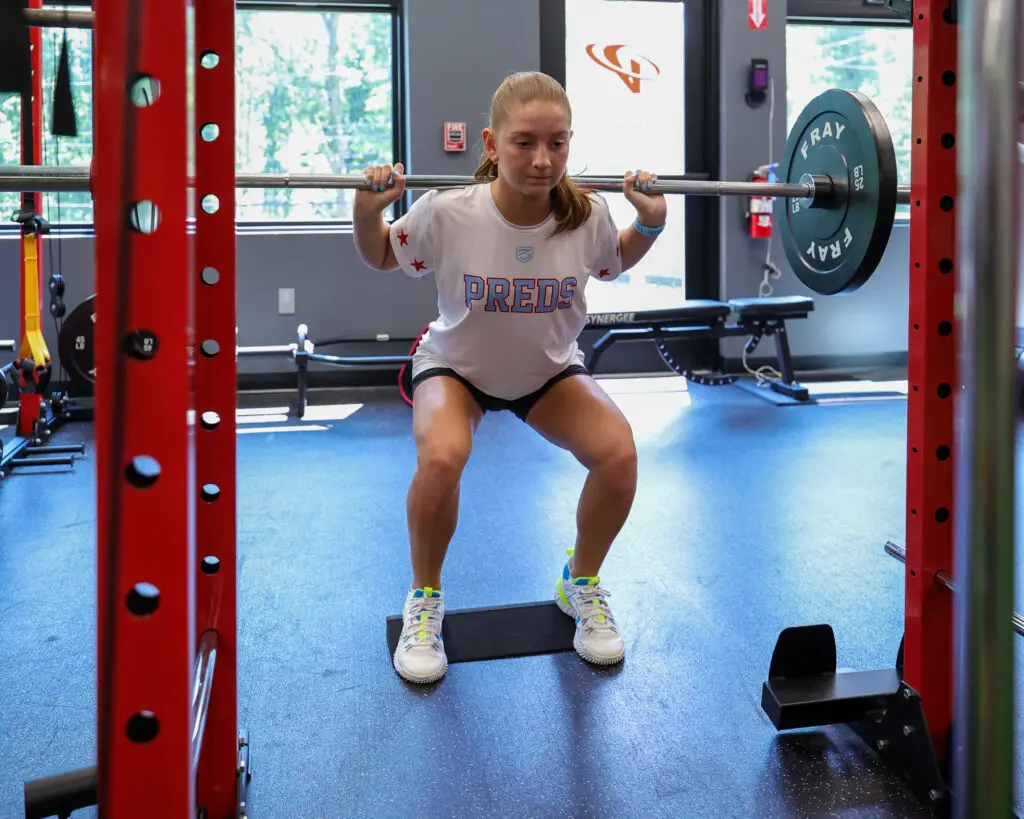
can help develop the physical qualities that contribute to sprint performance.
Research reviewing sprint-development methods has found that both specific sprint training and nonspecific methods such as resistance and power training can contribute to improvements in sprint performance (Rumpf et al., 2016).
Running more isn’t necessarily the missing piece.
Sometimes you need to become capable of producing more force, faster.
More Sprinting Isn’t Always Better Either
Now here’s the other side of the conversation.
If sprinting makes you faster…
Should you just sprint every day?
No.
Speed training is extremely demanding.
A true sprint isn’t conditioning.
It’s a maximal or near-maximal athletic effort.
When we’re developing speed, we want athletes producing high-quality repetitions with enough recovery to actually move fast.
If your first sprint is fast but your fifth, sixth, and seventh reps are dramatically slower because you’re exhausted, you’re no longer training the exact same quality.
You’re increasingly training the ability to perform while fatigued.
That can be useful.
But it’s a different goal.
Research on repeated-sprint training supports its usefulness for improving short-distance sprint performance and other qualities relevant to field and court athletes, but sprint development still needs to be programmed around the athlete and the specific quality being trained (Taylor et al., 2015).
When training pure speed, the goal isn’t to make you tired.
The goal is to make you fast.
Rest Is Part of Speed Training
This can be difficult for athletes to understand.
They’ll finish a sprint…
Wait 20 seconds…
And immediately want to go again.
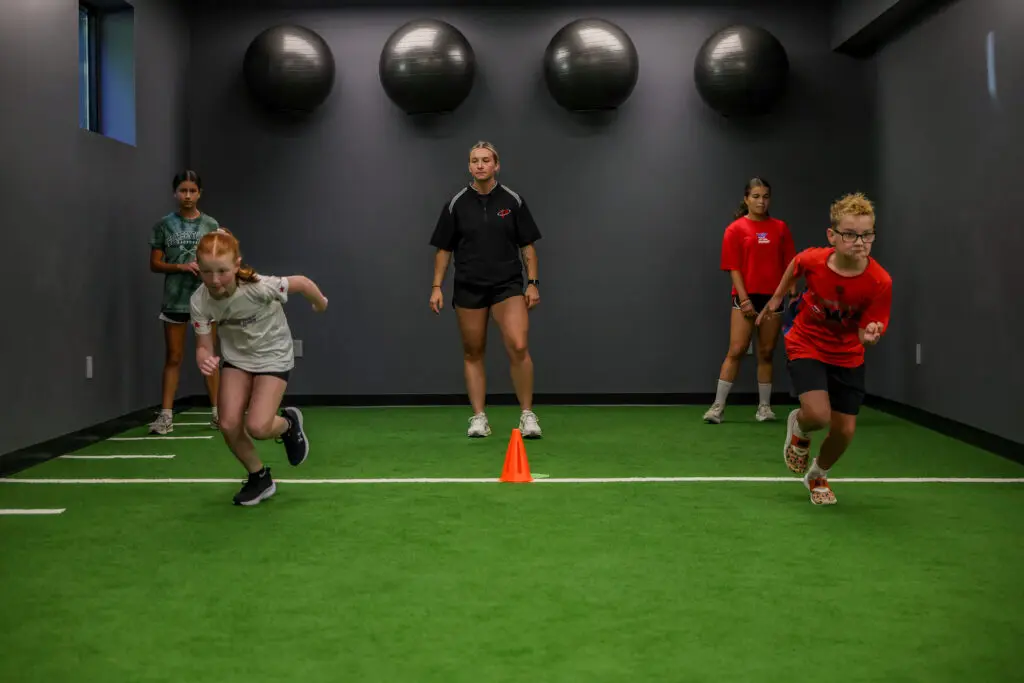
Because standing around doesn’t feel like training.
But recovery is one of the most important parts of developing speed.
If we want your next sprint to actually be fast, your body needs time to recover.
That’s why a good speed session might involve relatively few total sprints with significantly more rest than athletes expect.
You’re not being lazy.
You’re protecting the quality of each repetition.
Think about strength training.
If you’re trying to lift a near-maximal weight, you wouldn’t perform another set five seconds later.
You’d recover so you can produce another high-quality effort.
Speed works the same way.
Quality beats quantity.
What About Conditioning?
This is where the conversation needs some context.
We’re NOT saying athletes shouldn’t condition.
Conditioning matters.
Especially for athletes who play sports requiring repeated high-intensity efforts.
Soccer players need to repeatedly sprint, recover, and sprint again.
Basketball players need to transition up and down the court.
Lacrosse players need to repeatedly accelerate, decelerate, and change direction.
Research on repeated-sprint ability shows that athletic performance in these situations depends on multiple qualities, including single-sprint speed and the ability to recover between high-intensity efforts (Bishop, Girard & Mendez-Villanueva, 2011).
That’s why a complete athletic development program can include:
Speed training AND conditioning.
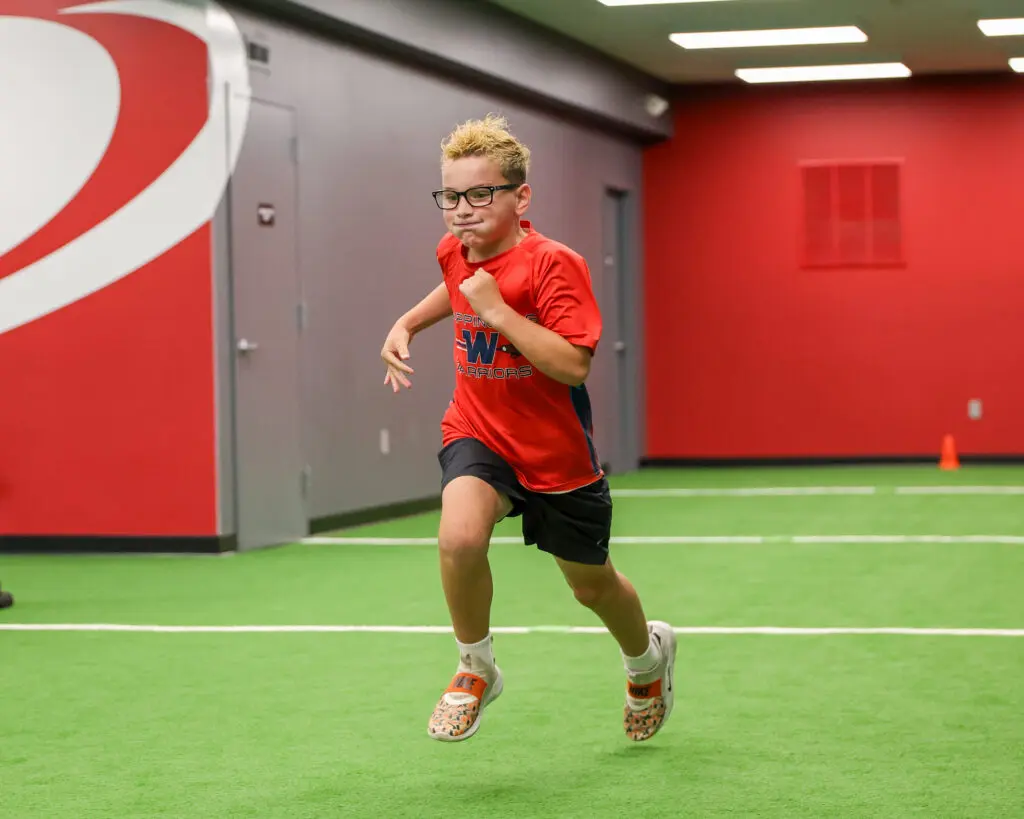
They just shouldn’t be confused with each other.
Your conditioning work develops your ability to maintain and recover from effort.
Your speed work develops how fast you can actually move.
You need both when your sport demands both.
Train for the Demands of Your Sport
Ask yourself:
How often during your sport are you running continuously at the same slow pace for several miles?
For some athletes—especially distance runners—that may be exactly what competition requires.
For many field and court athletes?
Not very often.
Their sports involve:
Sprint.
Stop.
Change direction.
Accelerate.
Decelerate.
Jump.
Recover.
Sprint again.
Training should prepare athletes for those demands.
That doesn’t mean every single conditioning drill needs to perfectly imitate the sport.
But your overall training program should develop the physical qualities your sport actually requires.
A soccer midfielder and a cross-country runner both run a lot.
But that doesn’t mean they should train exactly the same way.
Common Speed Training Mistakes
1. Thinking more running automatically means more speed
More volume can improve conditioning.
That doesn’t automatically improve maximal speed.
2. Turning every sprint workout into conditioning
If every sprint ends with your hands on your knees gasping for air, you’re probably not always training pure speed.
Sometimes the goal should simply be moving as fast as possible.
3. Not resting enough
Speed requires quality.
Quality requires recovery.
4. Ignoring strength and power
Sprint mechanics matter.
But your body still needs the physical ability to produce force.
5. Never actually sprinting
You can squat.
Jump.
Push sleds.
Do plyometrics.
Improve your mechanics.
All of those things can help.
But eventually…
If you want to sprint faster, you need to sprint fast.
Our Approach at Velocity
At Velocity, our goal isn’t simply to make athletes tired.
Anyone can create a workout that makes you tired.
Our goal is to create adaptations that make you a better athlete.
That means understanding the difference between training speed and training conditioning.
When we’re working on acceleration, we want high-quality explosive efforts.
When we’re working on top speed, we want athletes reaching high velocities with proper mechanics.
When we’re conditioning, we can manipulate work periods, recovery periods, distance, and intensity based on the athlete and their sport.
And when we’re developing strength and power, we’re building the physical engine that supports all of it.
Every piece has a purpose.
The goal isn’t to do more.
The goal is to do the right work for the adaptation we’re trying to create.
Final Thoughts
Running is not the same thing as sprinting.
And running farther doesn’t automatically make you faster over shorter distances.
Longer, slower running can be an extremely useful tool for developing aerobic fitness and conditioning.
But if your goal is improving acceleration and speed, you need to train those qualities directly.
Sprint fast.
Get stronger.
Develop power.
Recover between high-quality efforts.
Condition appropriately for your sport.
And understand why you’re doing each one.
Because becoming faster isn’t about seeing how many miles you can run.
It’s about teaching your body to produce more force, in less time, and use that force to move as efficiently and explosively as possible.
Don’t just run more.
Train to run faster.
Written By:
Jake Lebovitch – Assistant Director of Performance & Content Manager
References
Bishop, D., Girard, O., & Mendez-Villanueva, A. (2011). Repeated-sprint ability – Part II: Recommendations for training. Sports Medicine, 41(9), 741–756.
Kristensen, G. O., van den Tillaar, R., & Ettema, G. J. C. (2006). Velocity specificity in early-phase sprint training. Journal of Strength and Conditioning Research, 20(4), 833–837.
Rumpf, M. C., Lockie, R. G., Cronin, J. B., & Jalilvand, F. (2016). Effect of different sprint training methods on sprint performance over various distances: A brief review. Journal of Strength and Conditioning Research, 30(6), 1767–1785.
Taylor, J., Macpherson, T., Spears, I., & Weston, M. (2015). The effects of repeated-sprint training on field-based fitness measures: A meta-analysis of controlled and non-controlled trials. Sports Medicine, 45(6), 881–891.