

Don’t want to lose your off-season gains when they matter most?
Don’t want to lose your off-season gains when they matter the most? Time to start prioritizing in-season training. Here’s why:
Strength, in our opinion, is the single most important physical attribute that an athlete can possess as strength is literally the precursor to all forms of athleticism. Want to get instantly faster, more agile, quicker, more explosive, and maintain more endurance? Strength training will significantly enhance all of them. Adopting a ground-based, functional strength-training program that utilizes upper and lower-body, compound movements is genuinely the key to athletic success and longevity in our opinion.
The biggest challenge with strength and power training is that all the amazing benefits we associate with it from a scientific standpoint (i.e. increases in force production, speed of muscle contractions, inter-muscular coordination, enhanced ground-reaction time, etc.) are in fact reversible.

Yes, you read that, right!
All the hard work and performance gains an athlete makes during the off-season, or pre-season can, in fact, go away when this type of training is not maintained for prolonged periods.
Oftentimes, athletes and parents are confused when this happens. However, maintaining strength and power gains from the off-season doesn’t come from going through sport specific movements during practice. In fact, they come from doing similar movements that enhanced that strength and power in the first place.
Now, some may be asking… “Are off-season and in-season workouts the same?”, “Won’t I be sore if I am training in-season and playing my sport?”, or “How will I have enough time to train and play my sport?”

Let’s dive into it:
1. “Are off-season and in-season workouts the same?”
No!!!
Off-season training is meant to increase your strength, power, hypertrophy (size), and endurance. This will require strenuous exercises that could make you tired, sore, and left feeling as if your body has just “maxed out” its capacity.
However, in-season training is only meant for maintenance! The whole point of an in-season training program is to maintain the gains you made in the off-season. This requires a whole different plan to execute this goal.
What will change:
- Set and rep schemes will differ
- Intensity will differ
- Frequency will differ
Thus, leaving your body primed and ready for competition while assuring that the gains you made in the off-season do not diminish as you continue throughout your time on the field.
2. “Won’t I be sore if I am training in-season and playing my sport?”
Again, No!!!
When training hypertrophy in the off-season for example, the increased rep range, and time under tension, is breaking down the muscle fibers so that they can increase in size. This type of training will make you sore and fatigued.
However, when you train in-season the load stays high but the rep range decreases. Thus, maintaining strength and power but avoiding the time under tension required to create soreness.
Therefore, when training in-season, you can get all the benefits of your strength training while feeling primed and ready to compete in your sport.
3. “How will I have enough time to train and play my sport?”
Off-season and in-season training programs have different frequency requirements in order to achieve maximal results.
Compared to an off-season training schedule where you train 4-5x per week. In-season training volume is ideal if completed in a minimum of 2 training sessions per week.
Here is a scheduling example for an in-season athlete:
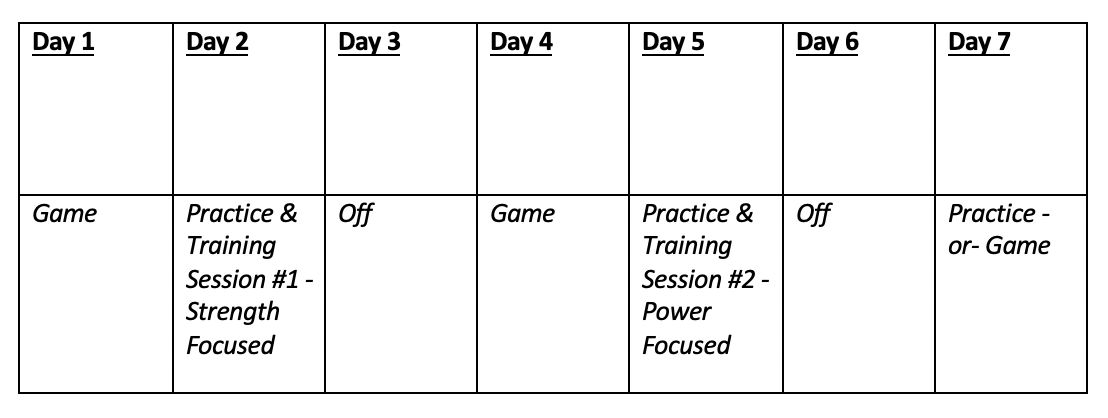
In our experience – and the experience of the athletes who train with us – this is all it takes to make sure you finish the season just as strong as you were at the start. In addition to performing well during your season, you will not need to “re-gain” your strength, power, etc at the end of each season. This effectively accelerates your performance at a greater rate than your peers.
So… what are we waiting for?
Let’s get in the gym and get to work on maintaining those gains and getting you ready to dominate your competition!
Written by:
Jake Lebovitch – Sports Performance Coach & Liaison to Athletes
Jordan Bledsoe – Owner & Director of Performance
